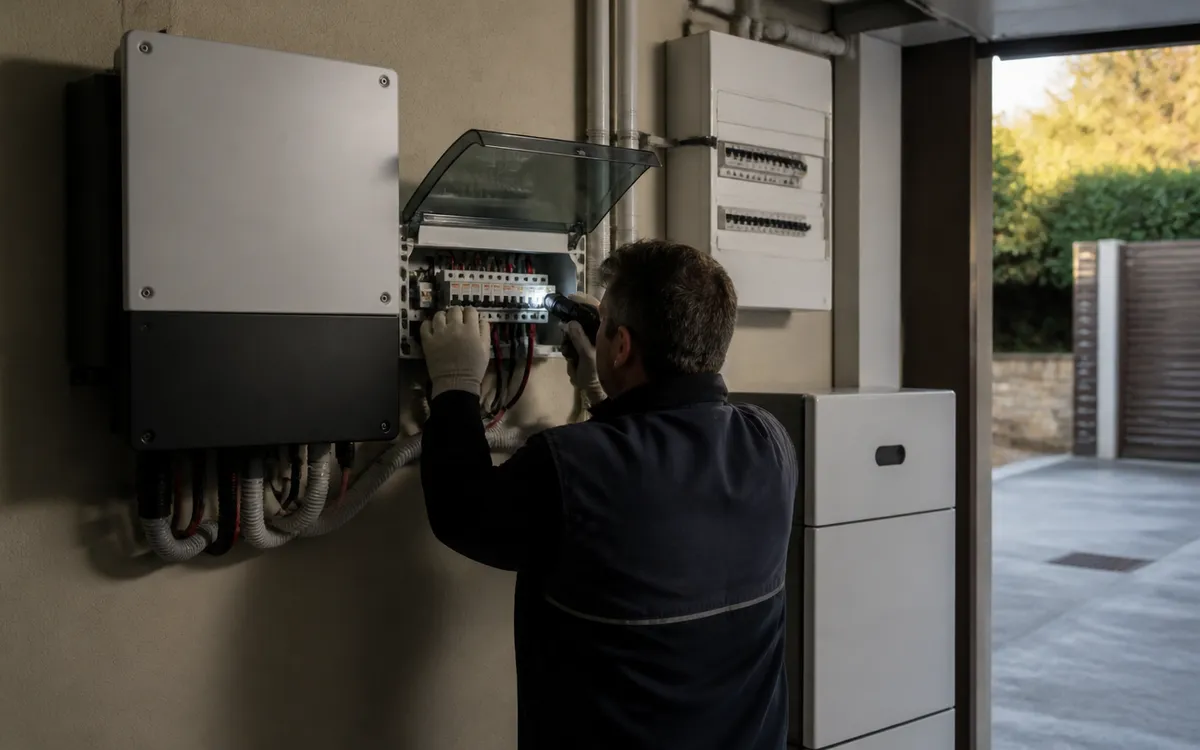
Solar panel, battery or electric car charger faults
An inverter that overheats, a battery that smells, a connector that sparks or a wallbox that blacks out the whole house cannot wait. We disconnect the faulty equipment, make the installation safe and locate the fault.
Solar panels, batteries and chargers: what it involves
Solar panels, batteries and charging points are now found in many homes, residential buildings, industrial units and shops across the Región de Murcia and the Alicante coast. They are reliable systems, but they handle a lot of power and have their own particularities: a solar PV installation produces direct current whenever there is daylight, even if you switch off the main switch; a lithium battery can overheat because of an internal fault; and an EV charger runs at full power for hours on end.
We deal with faults that pose a risk or affect the rest of the installation: melted connectors on the roof, inverters shutting down with a burning smell, PV protective devices that trip the main RCD (trip switch), batteries that swell or overheat, wallboxes that trip with every charge or damaged charging cables. First we isolate the equipment so the house keeps running on the grid, then we look for the cause.
Cases and jobs
Solar PV, battery and EV charging faults we handle
The ones we are asked for most, with an explanation, followed by the other jobs in this service.
Solar inverter overheating or smelling of burning
The inverter converts the direct current from the panels into alternating current for the house and, in the middle of summer days, it works very close to its limit. If it is somewhere without ventilation, in the sun or with its vents blocked, it overheats, cuts its output or shuts down; if it also smells of burning, the problem may lie in its connections or in a protective device. We disconnect the AC and DC sides using their isolators, check terminals, protective devices and wiring and establish whether the fault is in the equipment or the installation. If it needs moving somewhere cooler, we relocate it.
Melted connectors or sparks on the roof
The DC connectors between panels are a weak point: one that is badly crimped, mixed with a different manufacturer's or exposed to water creates an arc that melts the plastic and can set the roof on fire. Unlike AC, a DC arc does not go out by itself, which is why these faults are taken very seriously. We open the DC circuit with the isolator, locate the damaged connector by testing each string of panels, replace it with a compatible, properly crimped pair and check the rest of the string.
Lithium battery overheating or swelling
A battery that is hot without charging, deformed, making noise or giving off a sweet or chemical smell has an internal fault that can end in thermal runaway. If there is smoke, don't try to put it out: leave the room, close the door and call 112. If there is no smoke, we disconnect the battery from the installation using its protective device, separate it from the inverter, check the wiring, fuses and ventilation of the room and document the fault for the manufacturer. We don't open the battery itself: its manufacturer repairs it.
EV charger that trips the power
If the RCD trips every time the car starts charging, or the house loses power partway through a charge, there are three usual suspects: a contracted power level (potencia contratada) that isn't enough to charge and run the house at the same time, a wallbox supply line with undersized cable or protection, or a leak in the charger or the car itself. We check the line from the fuse box, the charging point's RCD protection, the earthing and the power setting on the charger. If there is no load management system, we install one so the wallbox reduces its power when the house is drawing current.
Solar PV system tripping the house RCD
In some homes the RCD trips mid-morning, when the inverter starts up or production rises, and nothing happens at night. It may be a leak on the DC side caused by damp in a box or a cable on the roof, an RCD that isn't the right type for that inverter, or a badly made PV connection in the fuse box. We test the insulation of the panel strings, check the type and position of the RCD and correct the wiring so the solar side doesn't knock out the rest of the house.
More cases we deal with
Panels damaged by hail or a storm
Broken glass, bent frames or panels lifted by the wind. We isolate the affected string, remove the damaged panels and check their wiring and mountings.
Chewed or bare solar cable on the roof
Pigeons, rodents or rubbing against metal sheeting strip the DC cables. We replace them with solar cable and protect them with conduit or cable tray.
Inverter that won't start after a lightning strike
A surge can damage the inverter and the AC and DC protective devices. We check the surge protectors and set aside whatever needs to go to the manufacturer.
Blown fuses in the DC combiner box
In installations with several strings, a blown fuse points to a short circuit or a damaged string. We find the cause before replacing it.
Wallbox overheating or smelling of burning
Loose terminals at the supply connection or a damaged internal component. We disconnect the charger, check the connection and tell you whether the fault is in the line or the unit.
Melted charger cable or connector
Connectors that have been stepped on, got wet or been forced, melting their contacts. We replace the charging cable or the socket and tell you whether the car's charging port should be checked.
Socket burnt from charging the car on a standard socket
A portable charger plugged into an old household socket for hours ends up burning it. We replace the socket or install a charging point with its own dedicated line.
Charging point in a communal garage that trips
A parking space with its own line that trips and stops charging. We check the line to the space, its protective devices and the building's load management system, if there is one.
Battery that cuts out and shuts the system down
A protective device tripping, a fuse or a loose connection between battery and inverter. We check the wiring and protective devices on that section.
Insulation alarm on an industrial unit's solar PV system
Large roofs with many strings where the inverter detects an insulation fault. We test string by string until we find the one that is leaking.
Off-grid country house without power
Panels, batteries and inverter-charger in homes with no grid connection. We find out whether the fault is in generation, the batteries or the inverter and keep the essentials running.
Hybrid inverter that doesn't provide backup during a power cut
Systems with a backup function that don't switch over to power the house from the battery when the grid fails. We check the changeover switch, the protective devices and the backup circuit.
What to do if you see smoke, sparks or heat in panels, batteries or a charger
If there is smoke or fire in a battery, an inverter or a charger, leave the room, close the door if you can and call 112. Don't throw water on live equipment and don't try to put out a lithium battery yourself.
If there is no smoke, stop the car charging from the vehicle itself or its app and switch off the charger's protective device in the fuse box. For solar PV, switch off the solar installation's protective device and, if the inverter has an external isolator switch and you can reach it without touching anything hot or damaged, turn it off.
Remember that the panels keep producing voltage while there is daylight, even if everything is switched off: don't touch cables or connectors on the roof. Take photos without going near and write to us.
What the regulations require for solar PV and EV charging
Self-consumption installations are governed by ITC-BT-40 of Spain's Low Voltage Electrotechnical Regulation (REBT), on low-voltage generating installations, as well as the self-consumption regulations. Among other things, they require dedicated protection for the generating side, a clear separation between DC and AC and suitable earthing.
Charging points have their own technical instruction, ITC-BT-52, which sets out how they are supplied, what RCD protection they need and what pre-installation garages require. When we carry out repairs, we follow these rules and, if we find something that doesn't comply (an inverter without its protective devices, a wallbox hanging off a socket circuit, a battery shut away without ventilation), we explain it and suggest how to put it right.
What we repair and what the manufacturer repairs
A solar or charging installation has two parts: the equipment (panels, inverter, battery, charger) and the installation connecting it all (wiring, connectors, protective devices, fuse box and earthing). We repair the installation and diagnose the equipment: we test, check and tell you, with readings, whether the fault is inside the unit.
If the fault is internal, the equipment is repaired by its manufacturer or the company that sold it. We give you a report with the readings, photos and what we observed, which is what they usually ask for to process the repair or replacement of the equipment.
What you get
What you get when we do it
Safety on both DC and AC
We separate the two sides of the installation and work knowing that the panels produce voltage while there is daylight.
The house stays on the grid
We isolate the faulty equipment so the home or business keeps running on the grid while it is repaired.
Diagnosis backed by readings
We tell you, with data, whether the fault is in the equipment or the installation, without swapping parts blindly.
Protection for everything else
We correct protective devices and connections so a solar or charging fault doesn't leave you without power again.
How we work
How we fix it, step by step
You explain what is happening
Which equipment is failing, what you see or smell and, if you can, a photo of the inverter, battery or charger, through the form or by email.
Safe disconnection
We separate the equipment from the rest of the installation on both the AC and the DC side.
Testing and diagnosis
String insulation, protective devices, connections, earthing and the charger's supply line.
Repair and start-up
We repair whatever belongs to the installation and document whatever needs to go to the manufacturer.
Frequently asked questions
Questions about solar panels, batteries and chargers
What should I do if the solar inverter smells of burning?
Switch off the PV protective device in the fuse box and, if the inverter has an external isolator switch and you can reach it without touching anything hot, turn it off. If there is smoke, get out and call 112. Don't open the inverter. Write to us with a photo and we will check the connections, protective devices and equipment.
If I switch off the main switch, do the solar panels switch off?
The inverter stops feeding power because it detects there is no grid, but the panels keep generating DC voltage while there is daylight, so the cables and connectors on the roof can be live with the house switched off. If your inverter is a hybrid with a backup function, it may also keep powering part of the house from the battery.
Why does the power trip when I charge my electric car?
Most often, the charger plus what the house is using exceeds your contracted power, and the meter cuts the supply. It can also be a charger line with undersized protection or cable, or a leak that trips the RCD. We check it and, if needed, adjust the charger's power or install a load management system.
My lithium battery is swollen. Is it dangerous?
Yes. A swollen battery has damaged cells and can heat up on its own. Don't use it, don't knock it and don't try to open it. If there is no smoke, switch off its protective device and write to us; if there is smoke or a lot of heat, leave the room and call 112.
When should a solar panel installation be checked?
Connectors, protective devices and terminal tightness should be checked periodically, and always after a storm, a hailstorm or a nearby lightning strike. On the coast, salty air speeds up the corrosion of boxes and connectors, and inland the summer heat takes its toll on poorly ventilated inverters.
Tell us what is happening, where it is and a phone number. In the meantime, if there is a burning smell, sparks or water, switch off the main switch only if you can do it safely.