
Skip to content
electricistaentrevegas.comReport a fault
Menu

Earth leakage: electric shocks from the shower, taps or appliances

If something in your home gives you a shock, current is escaping where it shouldn't and the protection is not doing its job. We find the leak, cut it off and leave your earthing and RCD in proper working order.

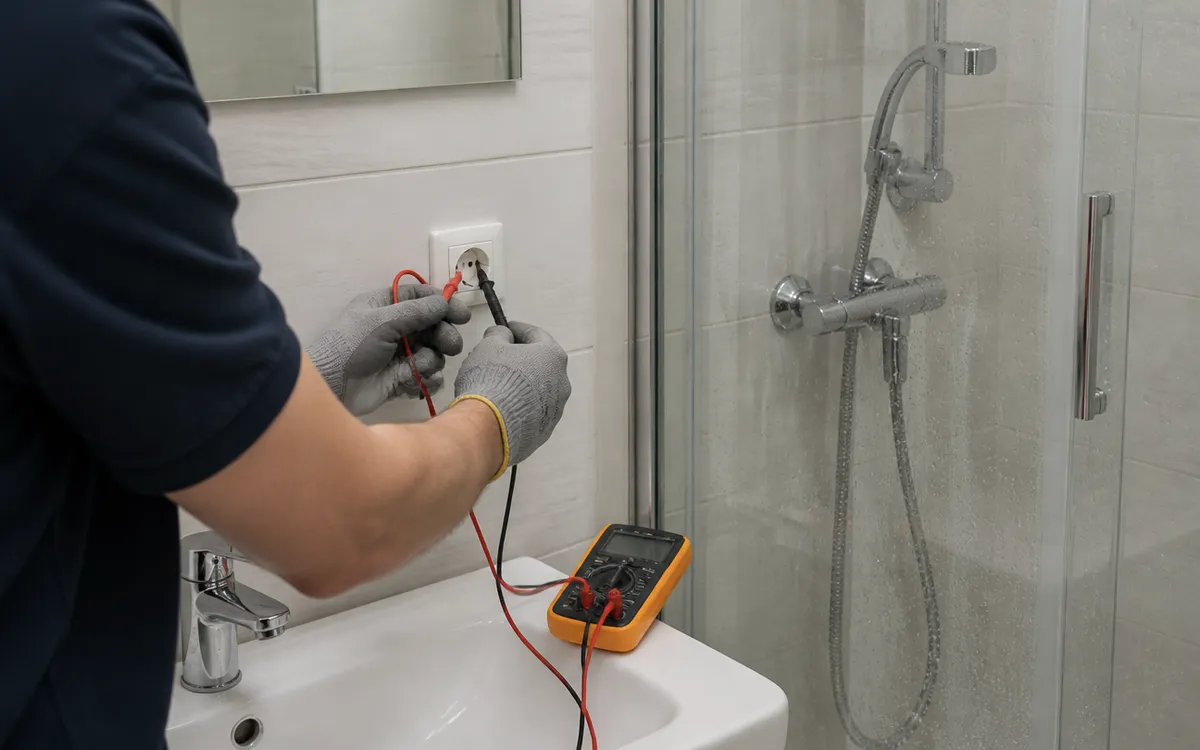
Electrician testing the earthing in a bathroom to trace an earth leakage

Electrical hazard emergencies

Earth leakage: what it involves

We talk about earth leakage when part of the current leaves its path and flows to earth through something that shouldn't conduct it: the casing of an appliance, the shower pipework, a tap, a metal structure or a damp wall. If the installation has good earthing and an RCD (residual-current device, the diferencial) that works, that leak is cut off instantly. If you are getting shocks, one of the two is failing.

The cause is usually an appliance with deteriorated insulation (the water heater, the washing machine, the oven, a pump), a cable that has lost its sheath inside the wall, or damp, which is very common in ground-floor properties, garages and coastal homes exposed to salty air. Sometimes the leak is small and only causes a tingling; at other times it trips the RCD again and again. We locate the appliance or the section that is leaking and leave the earthing and RCD in proper working order.

Cases and jobs

Earth leakage and electric shocks we track down

The ones we are asked for most, with an explanation, followed by the other jobs in this service.

I get electric shocks in the shower

This is the most frequent query and the most serious, because in the shower your body is wet and your skin conducts much better. The source is almost always the electric water heater with a deteriorated element or wiring, which makes the water and metal pipes live, combined with earthing that is missing or not working. We disconnect the water heater, test its insulation and that of the bathroom circuits, check the equipotential bonding and the earth, and leave the RCD working as it should. Until then, do not use the shower.

I get a shock from the kitchen tap

When the tap or the steel sink is live, the leak usually comes from a nearby appliance (the dishwasher, the hob, the oven or the fridge) or from the water heater, through the pipework. We unplug and test the kitchen appliances one by one and check the socket circuit and the continuity of the earth to each socket. If the home is old and the sockets have no earth, we explain how to bring it to the kitchen and bathroom.

Everything I touch gives me a shock

If you feel current in several places at once (taps, radiators, the fridge, the railing), the problem is not just one appliance: normally the earth is broken or has a very high resistance, so the leak from one appliance passes to every metal part connected to it, and the RCD is not tripping. Switch off the main switch and don't touch anything metal until we arrive. We measure the earth and the voltages on the metal parts, find the leaking appliance and the protection fault and repair both.

Earth leakage caused by damp in walls, ground floors and garages

In ground-floor properties, basements, garages and homes near the sea, damp and salt get into conduits, boxes and fittings and the cable insulation gradually deteriorates until the RCD starts tripping, especially in the early hours or on humid days. We test the insulation circuit by circuit to find the affected section, replace damaged cables and fittings and, where the damp won't go away, fit weatherproof boxes and sockets and reroute the conduit along a drier path.

The washing machine gives a shock when you touch it

A washing machine that gives you a shock almost always has a heating element or motor with damaged insulation, and is also plugged into a socket with no earth or a loose earth. We check the socket, the continuity of the protective conductor back to the fuse box and the appliance's insulation. If the fault is in the washing machine, we tell you so with the reading in hand so its technical service can repair it; if it is in the installation, we fix it ourselves.

More cases we deal with

  • Electric water heater that trips the RCD

    With limescale and age, the water heater's element ends up leaking to earth. We test it isolated from everything else and tell you whether the fault is in the element, the thermostat or the wiring.

  • Oven or hob that leaks when it heats up

    Some leaks only appear when the element is hot. We test with the appliance running and locate the failing component.

  • Fridge or chest freezer giving shocks

    Condensation on the compressor or on the rear connections. We check the socket, the earth and the appliance's insulation.

  • Shocks from the pool ladder or railing

    A pump, an underwater light or a junction box with water in it can make the pool live. We cut the pool's supply and check the lights, the filtration system and the equipotential bonding of the metal parts.

  • Garden lamp posts and spotlights giving shocks

    Outdoor lights with perished seals and buried boxes that fill with water. We open them, dry them out, remake the connections and leave the boxes watertight.

  • RCD that trips in the early hours or when it rains

    Typical of damp-related leakage: insulation drops with dew or rain. We test each circuit in those conditions and find the one that gets wet.

  • Older home with no earthing

    Two-wire installations where appliances have no path to discharge a leak. We install the earthing, run it to the sockets that need it and check the RCD.

  • Earthing with high readings or disconnected

    Corroded earth rods, connections cut during a renovation or a building's earthing that nobody tests. We measure the resistance, remake connections and add earth rods when needed.

  • Machine in an industrial unit giving shocks

    Motors, welders or workbenches with a loose protective conductor. We check the machine's supply line, the motor insulation and its earth connection.

  • Air conditioning leaking current because of condensation

    Water from the drip tray or condensate pump reaching the unit's connections. We check the supply, replace damaged connections and protect the box from water.

  • Shop fridges and bottle coolers leaking current

    In bars, butcher's shops and greengrocers, condensation causes leaks that black out the premises. We put the refrigeration equipment on separate circuits so one leak doesn't stop the rest.

  • Awning, shutter or motorised gate giving shocks

    Motors out in the open with their terminal box exposed to water. We check the motor, its connection and its earth.

What to do if something gives you an electric shock

Don't touch it again and, if it is the shower or a tap, don't use the water until it has been checked. If the shock comes from an appliance, only unplug it if the plug is in view and your hands and feet are dry; otherwise, switch off that circuit's breaker or the main switch.

If the RCD trips as soon as you reset it, leave it off. If someone is stuck to the current, don't touch them: first cut the power at the main switch or separate them using a dry, non-conductive object such as a wooden stick, and call 112. Even if the person seems fine after a shock, they should be seen by a doctor.

In the meantime, note which appliances were running, what time it trips and whether it coincides with rain, a shower or a piece of equipment starting up. That information makes the search much quicker.

Earthing and RCDs: what the regulations require

Spain's Low Voltage Electrotechnical Regulation (REBT) requires people to be protected against indirect contact, which is exactly what happens when you touch a live casing. In homes this is achieved with two components working together: an earthing system (ITC-BT-18) to which all exposed metal parts are connected, and a high-sensitivity 30 mA RCD that cuts the power as soon as it detects the leak (ITC-BT-24 and ITC-BT-25).

In bathrooms, ITC-BT-27 defines zones around the bath or shower tray that limit which appliances and fittings can be installed there, and requires accessible metal parts such as metal pipes and drains to be connected with a protective conductor: this is local equipotential bonding. That is why, when we trace an earth leakage, we always check that bonding and that the RCD trips both with its test button and with a tester.

How we trace an earth leakage

First we separate the appliances from the installation: we disconnect all equipment and see whether the leak persists. If it disappears, the cause is an appliance and we reconnect them one by one until we find it. If it persists, it is in the installation, and we test the insulation of each circuit between conductors and earth until we narrow down the section.

Intermittent leaks, the ones that only appear with damp or at night, take more patience: we test in those conditions and check outdoor boxes, terrace sockets, garden lights and everything exposed to the weather.

What you get

What you get when we do it

  • We find the source

    It isn't enough for the RCD to stop tripping: we track down the appliance or section that is leaking and leave it sorted.

  • Earthing tested

    We measure the earth and its continuity to the sockets, which is what stops a leak from passing through your body.

  • An RCD that responds

    We check that it trips when it should and replace it if it is worn or not the right type.

  • No unnecessary replacements

    If the fault is in an appliance, we show you the reading; we don't touch what works.

How we work

How we fix it, step by step

  1. You tell us where you get the shock

    What you touch, when it happens and whether the RCD trips. Tell us through the form or by email.

  2. We isolate and separate

    We cut the affected circuit and separate the appliances from the installation.

  3. We take readings

    Insulation circuit by circuit, earthing, continuity of the protective conductor and RCD tripping.

  4. We repair and test again

    We replace the cable, fitting or protective device and take readings again before we leave.

Frequently asked questions

Questions about earth leakage

Why do I get electric shocks in the shower?

Because the water or the taps are live, almost always due to an electric water heater with a damaged element or wiring, and because the earthing or the RCD is not cutting off that leak. It is a dangerous situation: don't use the shower, switch off the water heater's breaker or the main switch and write to us.

What is earth leakage and how is it detected?

It is current leaking to earth through something that shouldn't conduct it. You notice it because the RCD trips, because something gives you a shock or because an insulation test gives low readings.

Can damp cause earth leakage?

Yes, and on the coast and in ground-floor properties it is one of the most common causes. Water and salt reduce the insulation of cables, boxes and fittings, which is why some leaks only appear when it rains, in the early hours or in humid summer weather. We trace them by testing in those conditions and protect the installation with weatherproof materials.

I get a shock when I touch the car or a door handle. Is it earth leakage?

If it is a single dry spark when you touch the car door, a door handle or another person, it is usually static electricity and has nothing to do with the installation. If the shock happens every time you touch the same tap, appliance or railing, then it may well be earth leakage and it is worth having it checked.

My home has no earthing. What is the risk?

Many homes built before the 1990s don't have it, or only have it on some sockets. Current regulations require it in new installations and whenever an existing one is renovated or extended. Without it, a leak from an appliance reaches whoever touches it and only the RCD can cut it off: if the RCD fails, there is no other protection. That is why we recommend installing it.

Is a 'derivación' the same as the 'derivación individual'?

No. In Spanish, 'derivación individual' is the technical name for the line that runs from the meter to the home's fuse box (ITC-BT-15), a normal part of any installation. 'Derivación' as a fault means current leaking to earth.

You may also be interested in

Related services

RCD keeps tripping

RCD or breaker tripping with the oven, water heater, air conditioning or for no obvious reason: we test the insulation and eliminate the leak.

See the service

Rewiring

Old installations with no earthing or two-wire circuits, kitchen and bathroom refits, shops, new-build villas, air conditioning lines and swimming pools.

See the service

Is it happening right now?

Tell us what is happening, where it is and a phone number. In the meantime, if there is a burning smell, sparks or water, switch off the main switch only if you can do it safely.