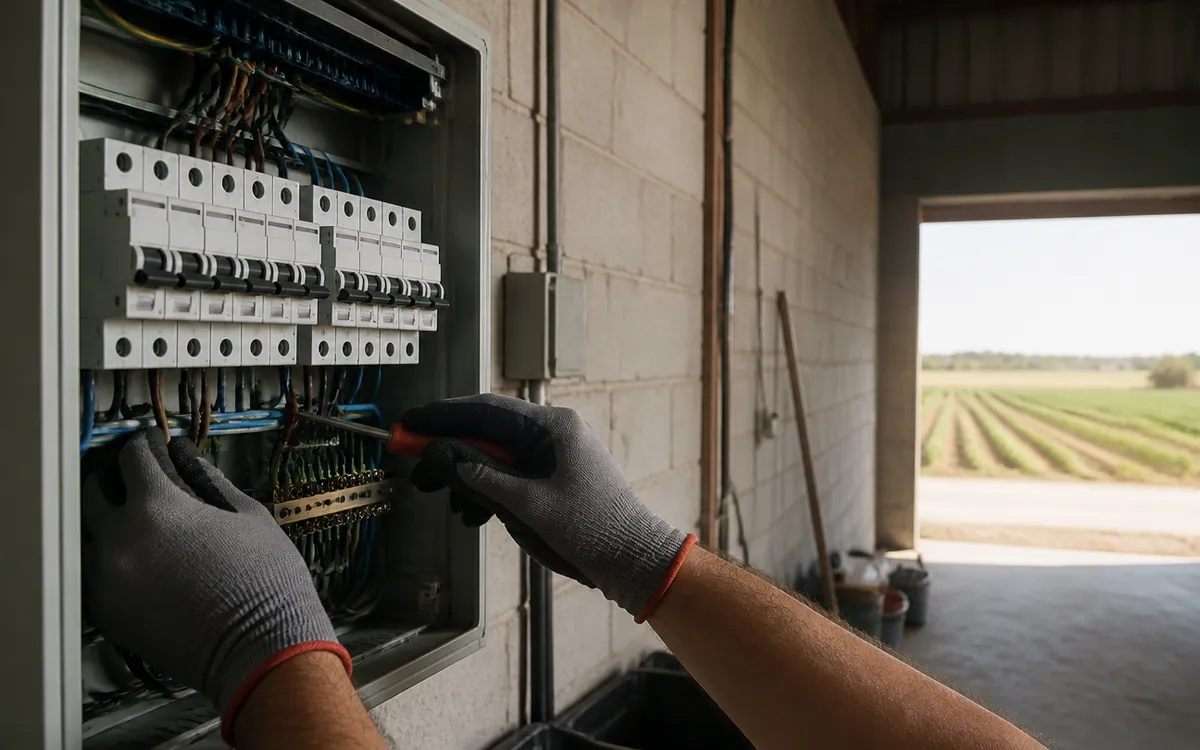
Electrical installation legalisation and power increases
We regularise installations that never had a certificate, adapt the installation when you need more power or a switch to three-phase, and prepare communities of owners and business premises for their periodic inspection.
Many installations run for years without being compliant: country houses extended bit by bit, premises that changed business, farm buildings in the huerta with a meter fitted decades ago, or homes whose paperwork was never registered. As long as nothing needs touching, nobody notices. The problem appears when you want to raise the power, change the contract, sell, open a business or pass an inspection.
Legalising an electrical installation means bringing it into line with the Low Voltage Electrotechnical Regulations (REBT) and documenting it: a technical design report or project, testing, the installation certificate and registration with the regional authority. First we check what is there, then we carry out the necessary upgrades and finally we prepare and file the paperwork.
A power increase (aumento de potencia) usually goes hand in hand with this. If the power you need fits within what your installation allows, you simply request it from your electricity supplier; if it doesn't, the individual supply line and the consumer unit have to be adapted and a new certificate issued. We tell you where you stand before you apply for anything.
Cases and jobs
Legalisations and power changes we handle
The ones we are asked for most, with an explanation, followed by the other jobs in this service.
Legalising an undocumented country house
Houses in the huerta or the Murcia countryside with the installation added piece by piece over the years, with no certificate or one that bears no resemblance to what is there. We inspect every circuit, fit earthing if there is none, replace the consumer unit with one with RCDs and a circuit breaker per line, and sort out the lines running to the irrigation pond, the porch or the storeroom. Then we write the technical report and the certificate for the installation as it really is.
Power increase in a home
Houses where the power trips when the oven and the air conditioning are switched on together, or that have added a heat pump, an induction hob or a car charger. We calculate the power you really need, check the maximum allowed on the certificate and the size of the individual supply line, and if it falls short we change what is needed and issue the new certificate. With the paperwork in order, you request the power from your supplier.
Switching from single-phase to three-phase
Workshops, industrial units and large villas that need three-phase power for motors, compressors, irrigation pumps or powerful climate control equipment. We renew the individual supply line with three phases, neutral and protective conductor, fit a three-phase consumer unit and spread the loads across the phases so they are balanced. With the new certificate, the change is requested from the distribution company, which replaces the meter.
Periodic inspection of a community of owners
Residential buildings with a total installed power above 100 kW, usually blocks with a garage, lifts and pumps, whose communal areas are inspected by an inspection body every ten years. We review the communal installation beforehand and correct anything that would be flagged as a defect: RCDs that don't trip, junction boxes without covers, emergency lighting with no battery life or poor earthing. If the report lists anything, we put it right.
OCA inspection of a bar or restaurant
Bars, cafés, restaurants and other premises open to the public are inspected by an accredited inspection body (OCA) every five years. We prepare the consumer unit, the circuits, the emergency lighting and the premises' documentation, and correct the defects the inspector points out so the installation is found compliant.
More cases we deal with
Technical design report for a small installation
Homes, small premises and extensions that don't need a project are documented with a technical design report (memoria técnica de diseño). We write it with the real circuits, cable sizes, protection and power.
Legalising a farm building or agricultural storehouse
Buildings with irrigation pumps, cold rooms or machinery connected without any paperwork. We adjust protection and earthing, separate circuits and leave the installation certified.
Premises changing business activity
From office to café or from storeroom to gym: the new activity changes the load and what the regulations require. We adapt the installation and prepare the documentation for the opening licence application.
Lowering your contracted power
If you are paying for power you don't use, we calculate which appliances in your home run at the same time so you contract just what you need without being left in the dark while cooking.
More power at night to charge the car
Domestic contracts have one power level for peak and standard hours and another for off-peak hours. We calculate both so the charger or the water heater can run at night without the power tripping.
Extension with a loft, porch or annexe
Extensions fed from the nearest socket end up overloading the installation. We connect them to the consumer unit with their own protection and include them in the documentation.
Correcting the defects in an inspection report
If you have already had the inspection and the report lists defects, we correct them in order of severity and leave everything ready for the inspection body to verify they have been remedied.
Legalising solar panels for self-consumption
Photovoltaic systems installed without registration or without their electrical documentation. We check the protection, the DC and AC wiring and the earthing, and prepare the certificate for registration.
Splitting the house and the ground floor into two supplies
Houses with a ground floor used as a shop or garage that shares a meter with the home. We prepare two separate installations, each with its own individual supply line and certificate.
Power increase for a café or bakery
Businesses that add a large coffee machine, an oven or cold rooms and start losing power in the middle of the working day. We calculate the power, adapt the supply line and the consumer unit and certify the new power.
Power for a well or irrigation pump
Wells and irrigation ponds with motors that draw a lot of current on start-up. We size the line and the motor protection and document the power required.
When you need a new certificate to raise the power
Every certificate states the maximum allowable power of the installation, which depends mainly on the size of the individual supply line (derivación individual), the cable running from the meter to your consumer unit, and on the main switch. If the power you want is below that figure, the increase is requested from your supplier and the distribution company applies it without any work. With digital meters, the meter itself acts as the limiter.
If it is above that figure, or if there is no certificate, the installation has to be adapted and a new certificate issued. The usual step is replacing the individual supply line with a thicker cable and changing the main switch, and sometimes the whole consumer unit. The distribution company may also charge fees for the additional power; that is its own charge, separate from the electrician's work.
For homes, the regulations distinguish between basic and high electrification. High electrification applies to houses with electric heating or air conditioning, with more than 160 m² of usable floor area or with more appliances than basic electrification allows for, and it means more circuits and a higher-rated main switch.
Periodic inspections: who has to pass them
ITC-BT-05 requires certain installations to undergo a periodic inspection by an accredited inspection body (OCA). The most common among communities and businesses are:
The inspection is carried out by the inspection body, not the electrician. We review the installation beforehand, correct anything that would be flagged as a defect and, if the report lists any, put them right so the installation is found compliant.
Premises open to the public, such as bars, cafés, restaurants or hotels: every five years.
Communal areas of residential buildings with a total installed power above 100 kW: every ten years.
Industrial installations that required a project and exceed 100 kW: every five years.
Swimming pools over 10 kW and outdoor lighting over 5 kW: every five years.
Technical report or project: what your installation needs
Most homes, small premises and extensions are legalised with a technical design report, written by the electrical contractor with the installation's details: power, diagram, circuits, cable sizes and protection. Higher-power installations and some types of premises need a project signed by a suitably qualified engineer; if that applies to you, we tell you during the inspection and coordinate it.
Electrical legalisation is not a substitute for planning regularisation: if a building has to be regularised with the town hall, that procedure is entirely separate.
What you get
What you get when we do it
A diagnosis before you apply
You know whether your power increase is just paperwork or needs work before you speak to your supplier.
Your real installation, documented
The report and the certificate cover what is actually there, including extensions that were never declared.
Inspections without surprises
We review the community or the premises before the inspection body arrives and deal with any defects afterwards.
Power tailored to you
We calculate the power based on your appliances and how you use them, including whether a different level at night makes sense.
How we work
How we fix it, step by step
Tell us what you need
Write to us with the type of property, your current power and the power you want, or with the inspection notice you have received.
Inspection and calculation
We inspect the installation, the individual supply line and the consumer unit, and calculate power and cable sizes.
Upgrade
We make the necessary changes: earthing, consumer unit, supply line, phase balancing or the defects listed in a report.
Paperwork and registration
We write the report and the certificate, file them with the regional authority and explain the next step with your supplier.
Frequently asked questions
Questions about legalisation and power increase
Do I need a new certificate to increase my electricity power?
Only if the power you want exceeds the maximum allowed on your certificate, or if you have no certificate. If it fits, your supplier processes the increase without further ado. If it doesn't, we adapt the individual supply line and the consumer unit and issue a new certificate. To find out, it is enough to look at your current certificate or, if it can't be found, to inspect the installation.
How much does it cost to legalise an electrical installation?
It depends on its condition: documenting an installation that already complies is not the same as fitting earthing, replacing the consumer unit and redoing circuits. The size of the property also matters, as does whether a technical report is enough or a project is needed, the power, the regional fees and whatever the distribution company charges if there is a new connection or a power increase. We give you an itemised quote after inspecting it.
Can a country house or an old industrial unit be legalised?
Yes, by bringing the installation into line with current regulations. Whatever doesn't comply is changed (earthing, consumer unit, cable sizes, joints outside junction boxes, mixed circuits) and whatever is fine is kept and documented. If the property has no service connection, the distribution company has to study the connection. And remember that electrical legalisation does not regularise the building with the town hall.
What is needed to switch from single-phase to three-phase?
An individual supply line with three phases, neutral and protective conductor, a three-phase consumer unit with its protection, the circuits spread across the phases, a new certificate and an application to the distribution company, which checks whether its network allows it at that point and changes the meter. In buildings with a central meter room, you also need to check there is space for the three-phase meter.
How often does a community of owners need an electrical inspection?
The communal areas of residential buildings with a total installed power above 100 kW undergo a periodic inspection every ten years. Smaller buildings have no such obligation, although checking the communal services consumer unit, the garage and the emergency lighting from time to time prevents faults. Premises open to the public within the building follow their own schedule.
What happens if the inspection finds defects?
The report classifies them as minor, serious or very serious. With minor defects the result is favourable and they are noted for correction; with a serious one it is conditional and there is a deadline to remedy them; with a very serious one it is unfavourable and the affected part cannot remain in service until it is corrected. Send us the report, we go through it with you and correct whatever it lists.
Can I have one power level by day and another at night?
Yes. Current domestic contracts include two power levels: one for peak and standard hours and another for the off-peak period. It is useful if you charge the car or heat water at night. We calculate both based on your appliances, and if the off-peak level exceeds the maximum the installation allows, we upgrade it first.