Electrician in Molina de Segura: urbanisations, town centre and industrial estates
We work in the villa urbanisations, the town-centre flats and the industrial estate units of Molina. We track down earth leaks in gardens and pools, renew installations and handle certificates and power increases.
Molina de Segura, north of Murcia on the banks of the Segura, in practice has three different electrical realities. The town centre grew quickly on the back of the canning industry and is full of blocks of flats from the seventies and eighties. Around it spread urbanisations of villas with plots, pools and gardens, some of them several decades old. And the industrial estates hold food, logistics and workshop units that depend on their installation to keep working.
On the urbanisations the typical problem is outside the house: buried lines feeding the pool pump, the garden lighting, the gate or a shed, laid years ago without conduit or with inspection pits that flood when the garden is watered. Over time they lose insulation and earth leaks appear that trip the RCD at night or when the sprinklers come on. On top of that, many villas have seen a jump in consumption: a heat pump, air conditioning in every room, solar panels and, more and more often, an electric car in the garage.
In the town-centre flats, forty-year-old installations dominate, with few circuits, consumer units with a single RCD and supply cables from the meter only just big enough for the power people need today. In the outlying districts, such as La Ribera de Molina or El Llano de Molina, village houses and huerta homes with their own additions sit side by side. On the industrial estates, what we see most are lost phases, cold rooms left without power, overheated sub-distribution boards and machinery extensions that need a new line.
Cases and jobs
Typical jobs in villas, flats and industrial units in Molina de Segura
The faults and jobs we come across most here. Each one links to its service.
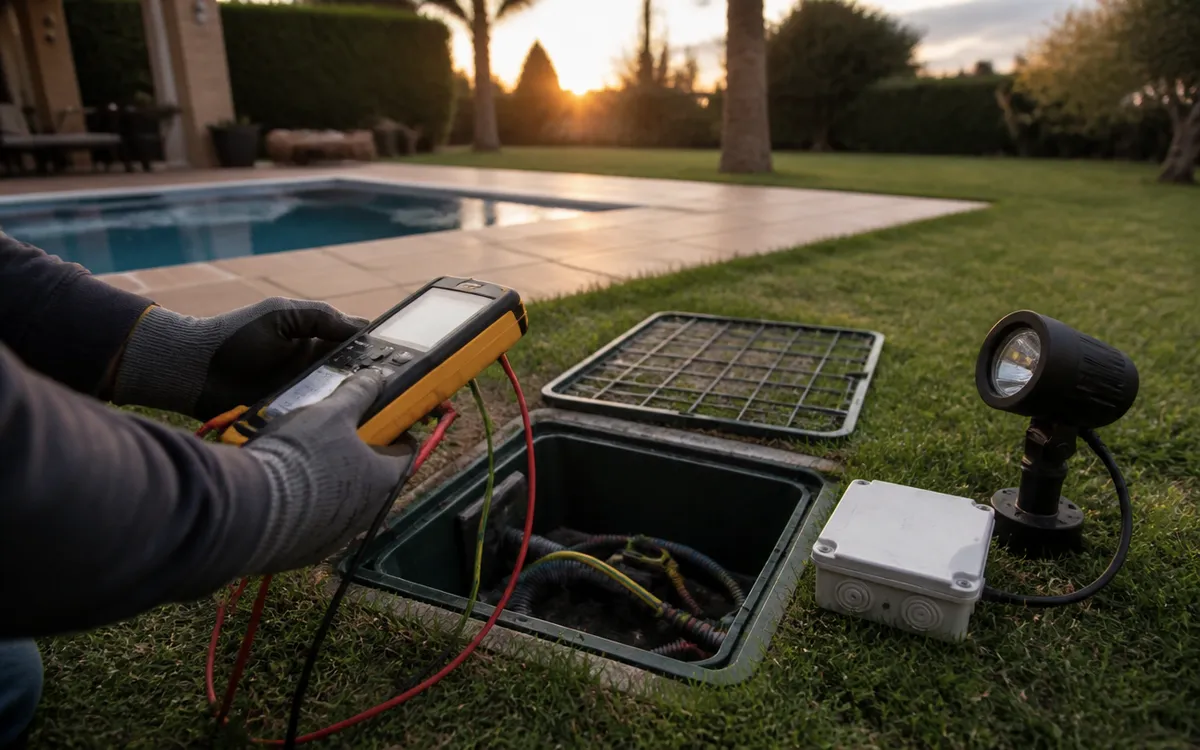
Irrigation water reaches a buried junction box or a garden light and the RCD cuts out. We measure the insulation of each outdoor line, replace the damaged section and raise the connections into weatherproof boxes above ground.
We disconnect the pump, locate the leak in the motor, the cable or the pump-house board, and leave the pool with its own RCD and equipotential bonding, as required by ITC-BT-31.
Digging a trench for irrigation or putting up a fence pierces the line to the gate or the shed. We cut the power, replace the section and leave it in conduit with an accessible inspection pit.
We give the charger its own line from the consumer unit with its own protection, and set it to the contracted power so the main switch does not trip while the car charges and the oven or air conditioning are running.
We check the DC and AC protections, the condition of the connectors and the insulation of the solar array, and isolate the fault so the home keeps its power while the photovoltaic system is repaired.
We rewire the installation room by room, with separate circuits for lighting, sockets, kitchen, washing machine and bathroom, as set out in ITC-BT-25, and replace switches, sockets and boxes.
We find out why the equipment has lost power, whether it is a tripped circuit breaker, a lost phase or a burnt-out contactor, and get the cooling back on so the stock is not lost.
In the town-centre blocks, if the supply to the booster pump fails, the upper floors are left without water. We check the pump board, the motor protection switch and the controls and get it running again.
We calculate the real power the villa needs, check the supply cable from the meter and the consumer unit, and handle the increase or the move to three-phase when the load justifies it.
We replace old floodlights and halogens with weatherproof LED fittings, put the outdoor lighting on its own circuit and add a sensor or timer so it only comes on when needed.
We check the motor supply, the control board, the photocells and the remote receiver so the gate opens and closes again without forcing it.
Pools and gardens: where earth leaks hide on the urbanisations
In an urbanisation villa, an earth leak is hardly ever inside the house. It is usually in a junction box buried in the lawn, a pool light with a worn seal, the gate cable crossing the driveway or an outdoor socket reached by the sprinklers. Since everything hangs off the same RCD, when one of those lines fails the fridge goes off too.
We measure the insulation of each outgoing circuit on the board until we find the one with the leak, follow it to the exact spot and replace it. Then we reorganise the board so that outdoor uses have their own RCD and a fault in the garden does not leave the house in the dark.
Pool lights on safety extra-low voltage, with the transformer outside the pool basin
Weatherproof connection boxes out of reach of the sprinklers
Outdoor lines in conduit with accessible inspection pits
Separate RCD for the pool and garden
Molina's industrial units: when a fault stops production
Molina's industrial estates have a lot of food industry, warehouses and workshops with three-phase machinery, cold rooms and compressors. A lost phase, a sticking contactor or a badly sized protection device leaves an entire line stopped, and every hour without production counts.
We locate the fault in the main board or the sub-boards, restore power to critical equipment and then propose the improvements that stop it happening again: surge protection, properly graded protection so one trip does not shut down the whole unit, and re-tightening of connections that run hot.
Undocumented installations, power increases, single-phase to three-phase upgrades, technical reports and periodic inspections for communities and shops.
Do you work on all the urbanisations in Molina de Segura?
Yes. We cover La Alcayna, Altorreal, Los Conejos, El Chorrico and the other urbanisations in the municipality, as well as the town centre and districts such as La Ribera de Molina, El Llano de Molina, Torrealta, Campotéjar and El Fenazar. Give us a reference for the plot in the form so we can find it without driving around.
What do the regulations require for a swimming pool's electrical installation?
ITC-BT-31 of the Low Voltage Regulations divides the pool into zones and limits which equipment can go in each one. Underwater lights run on safety extra-low voltage, the pool pump needs RCD protection and metal parts are connected to equipotential bonding. In older villas it is common for one of these things to be missing, and we correct it when we carry out the repair.
Can I install an EV charger if I have solar panels?
Yes. The charger has its own line and protection in line with ITC-BT-52, and it is set to the contracted power so it does not trip the main switch when it coincides with the oven or air conditioning. If the inverter and charger support it, they can be coordinated to charge from solar production.
My villa still has the urbanisation's original installation. Does it need renewing?
That depends more on its condition than on its age. We measure the insulation, check the earthing, look at the consumer unit and see whether the circuits can cope with today's load. If there are dried-out cables, buried joints or a board without suitable RCDs, we suggest renewing in stages: first the consumer unit and the outdoor lines, which is where most faults appear, and then the inside.
Do you handle emergencies in units on Molina's industrial estates?
Yes. We deal with lost phases, boards that keep tripping, cold rooms that have stopped and equipment that won't start in industrial units and commercial premises. Tell us in the form which equipment is affected and whether the unit has a generator or UPS, so we bring what is needed from the start.