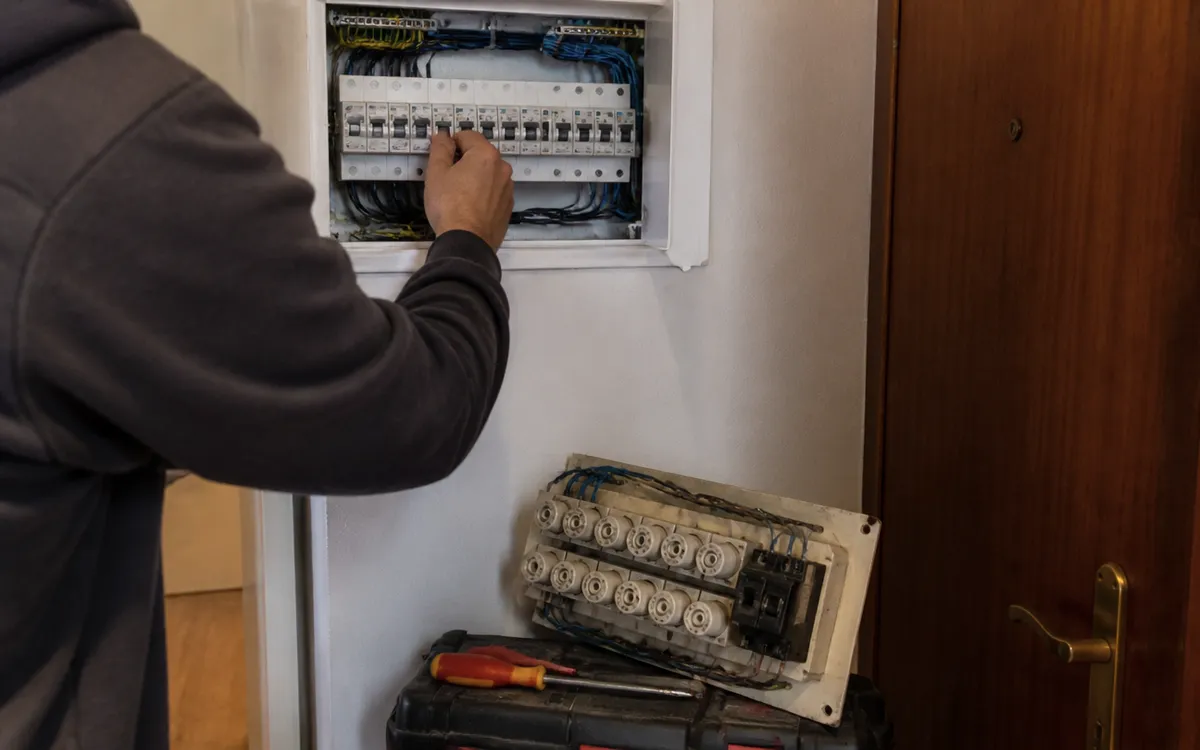
Fuse box replacement for homes, communities and business premises
We replace consumer units with fuses or a single RCD with a new one with protection for each circuit, the right RCDs and a surge protector, and we move it when it is in the way.
The consumer unit, or main control and protection board (cuadro general de mando y protección), is the part of the installation that protects you and your home. The main switch cuts everything off, the RCDs detect current leaks that could cause an electric shock and the circuit breakers protect each circuit against overloads and short circuits. If the unit is old, that protection is partial or simply doesn't exist.
In homes in Murcia and on the coast we still find fuse boxes with porcelain fuses, a thirty-year-old RCD for the whole house or boxes where breakers have been added with no order. We replace the whole unit, separate the circuits, check that each protective device matches its cable size and label everything.
We also move the consumer unit when a renovation leaves it in the wrong place, and we extend it when air conditioning, an induction hob, solar panels or a car charger arrive.
Cases and jobs
Consumer units we replace and extend
The ones we are asked for most, with an explanation, followed by the other jobs in this service.
Replacing a fuse box with a new consumer unit
Fuse boxes with porcelain fuses, the classic plomos, which don't protect people and which more than one person has 'fixed' with a bit of wire. We remove the old unit, fit a new enclosure with a main switch, 30 mA RCDs and a circuit breaker per circuit, separate lines that were combined and check the earthing. When we finish, we test each RCD with its test button and with a tester, and label every circuit.
High-immunity RCDs for electronics
Fridges, freezers, computers, routers, cameras, inverter air conditioning and LED lamps produce small leaks and disturbances that make standard RCDs trip without any fault. We fit high-immunity RCDs (superinmunizados) on the circuits with the most electronics and spread the lines across several RCDs, so a single trip doesn't plunge the whole house into darkness or stop the freezer while you're away.
Surge protection in the consumer unit
Late-summer storms, switching operations on the grid and neutral faults on the service connection can send voltages into the installation that burn out the boiler, the air conditioning or the television. We fit transient surge protection in the consumer unit, which diverts spikes to earth, and, where advisable, permanent overvoltage protection, which cuts the supply if the voltage stays above normal. We check the earthing, because without it the protector is useless.
Moving the consumer unit
A kitchen refit, a corridor that disappears or a built-in wardrobe sometimes leaves the consumer unit in an impossible spot. We move it to an accessible wall near the entrance, renew the individual supply line to the new location, extend the circuits with connections in accessible junction boxes and fit it at the regulation height. If it coincides with a renovation, we take the opportunity to put each circuit on its own line.
Adding circuits for air conditioning, induction or a charger
Consumer units with every slot taken that now need to take the air conditioning, the induction hob, the water heater or the charging point. We extend the enclosure or replace it with a larger one, add the circuit breaker for each new circuit with its cable size and spread the loads across RCDs, so a fault on one line doesn't leave the rest without power.
More cases we deal with
A single RCD for the whole house
When it trips, the whole home loses power and it is hard to tell which circuit is at fault. We split the circuits across two or more RCDs and, while we're at it, track down the leak that was tripping it.
Consumer unit in a beach home with salt damage
Rusty terminals, breakers that won't reset and an enclosure yellowed by sun and damp in coastal apartments. We replace the unit and choose an enclosure and switchgear designed for salty air when the unit is close to the outside.
Communal services board for a community of owners
Stairwell, entrance, garage, lift and pumps all hanging off the same old board. We renew it with separate circuits, RCDs for each service and the emergency lighting on its own line.
Consumer unit for a bar or shop
Premises with a coffee machine, cold rooms, oven and climate control spread over a few lines. We build a unit organised by area and equipment, with high-immunity RCDs on the refrigeration side and protection sized for each machine.
Three-phase board for an industrial unit or workshop
Balanced phase distribution, motor protection and RCDs suited to variable frequency drives and machinery.
Sub-board for a floor, a garage or an annexe
Two-storey villas, garages with a workshop or guest houses with their own sub-board fed from the main unit, so that area can be isolated and protected without cutting power to the whole house.
Consumer unit for solar panels and batteries
We integrate the inverter protection, battery switchover and backup circuits in a tidy unit, kept separate from the home's unit when the installation requires it.
Removing the old power control switch
With a digital meter, power limiting is done by the meter itself and the old power control switch (ICP) in the box is no longer needed. When we renew the consumer unit we remove it and leave the main switch at the head of the board.
Labelling an unlabelled consumer unit
Consumer units where nobody knows which breaker serves which area. We identify each circuit, label it and leave a simple diagram on the cover.
Consumer unit that gets hot or has dark terminals
Loose terminals and breakers working at their limit heat up the unit. We tighten or replace whatever is damaged and, if the enclosure has deteriorated, we replace it entirely.
The right RCD for equipment with power electronics
Inverter washing machines, induction hobs, pumps with variable speed drives and chargers need RCDs that properly detect their leakage currents. We choose the type of RCD according to the appliance it protects.
What a modern consumer unit includes
A home consumer unit compliant with ITC-BT-17 and ITC-BT-25 is placed close to where the individual supply line enters and includes, as a minimum:
On top of that minimum, the sensible approach in a home today is to spread the circuits across several RCDs, use high-immunity RCDs where there is sensitive electronics and leave spare slots for future additions.
An automatic main switch, which cuts off the whole installation and protects the individual supply line.
One or more 30 mA RCDs, which protect people against earth leakage.
A circuit breaker per circuit, rated to match the size of the cable it protects.
Surge protection in the situations set out in ITC-BT-23.
Why the RCD trips with no apparent fault
Every appliance with electronics lets a small current leak to earth. When many share the same RCD, those leaks add up and, with a storm or a compressor starting, they exceed the threshold and the RCD trips. It is the house where the power goes off 'for no reason' or when nobody is home.
The solution is not a less sensitive RCD, but spreading the circuits and using high-immunity RCDs where it makes sense. First we rule out a genuine earth fault with measurements, because deteriorated insulation causes the same symptoms and in that case the circuit needs repairing.
Moving the consumer unit: what to bear in mind
The consumer unit has to be as close as possible to the point where the individual supply line enters the home, accessible and, in homes, at a height of between 1.4 and 2 metres from the floor. It shouldn't be hidden behind fixed furniture or in a place where you have to move things to reach it in an emergency.
If the move is short, we extend the circuits from the current position in accessible junction boxes; if it is long or the supply line is old, we renew it completely. In blocks of flats, any change to the supply line running through communal areas is coordinated with the community of owners.
What you get
What you get when we do it
Protection where it matters
RCDs on every circuit: if an appliance develops a leak, the protection acts before anyone gets a shock.
Fewer trips for no reason
Circuits spread out and high-immunity RCDs on the electronics: the fridge keeps running even if another line fails.
Faults that are easy to find
Each circuit on its own labelled breaker: you know what has tripped and which area has lost power.
Ready to expand
Spare slots for the air conditioning, the induction hob or the car charger without replacing the enclosure again.
How we work
How we fix it, step by step
Checking the unit and circuits
We open the consumer unit, identify each line, measure insulation and earthing and see which appliances you have.
Consumer unit proposal
We explain how many circuits and RCDs are needed, which surge protection is advisable and where the unit will go.
Installation
We cut the supply, remove the old unit, fit the new one and connect each circuit to its protective device.
Testing and labelling
We test each RCD, check the earthing, label the unit and show you which area each switch controls.
Frequently asked questions
Questions about fuse box replacement
How much does it cost to replace a home's consumer unit?
It depends on the number of circuits, whether lines that are currently combined need separating, the type of RCDs (standard or high-immunity), whether surge protection is added, whether the unit is moved, the condition of the earthing and whether the installation is single-phase or three-phase. If the change alters the certified installation, updating the documentation also counts. After seeing it we give you a detailed quote.
Is it compulsory to replace an old fuse box?
If the installation isn't touched, the regulations don't generally require it to be replaced just because of its age. But when you need a certificate, a power increase or a renovation, the installation has to meet current regulations, and a unit with no RCD or with fuses doesn't. It is also the upgrade that most reduces the risk of electrocution in an older home.
What is a high-immunity RCD?
It is a 30 mA RCD that protects people just like a standard one, but is designed not to trip because of the high-frequency currents and small leaks produced by electronic equipment, or the disturbances caused by a storm. It is used on circuits for fridges, computers, cameras, alarms or air conditioning, where an unnecessary trip causes more problems.
Can the consumer unit be moved?
Yes. We move it to an accessible wall, close to where the individual supply line enters and at the height set by the regulations. We renew or extend the supply line and bring the circuits to the new point in accessible junction boxes. It is a good moment to separate circuits and fit new RCDs.
Do I need a new certificate when the consumer unit is replaced?
It depends on what changes. Replacing the protective devices with equivalent ones doesn't alter what was certified. Adding circuits, moving the individual supply line or changing the power does alter the installation, and the right thing is to update the documentation. We tell you before we start.
Is a surge protector worth fitting?
In areas with summer storms, with overhead service connections or with expensive appliances plugged in all day, yes. A transient surge protector diverts to earth the spikes from a nearby lightning strike or a switching operation on the grid; a permanent overvoltage protector disconnects the installation if the voltage stays high, for example due to a neutral fault. It needs good earthing, so we check it when we fit it.
Old installations with no earthing or two-wire circuits, kitchen and bathroom refits, shops, new-build villas, air conditioning lines and swimming pools.
Undocumented installations, power increases, single-phase to three-phase upgrades, technical reports and periodic inspections for communities and shops.