
Skip to content
electricistaentrevegas.comReport a fault
Menu

Damaged electrical cables: bare, drilled through or ripped out

A cable with the copper showing, pierced by a drill bit or left hanging after a gust of wind is a direct risk of electric shock and fire. We cut the power, isolate the area and repair it the way it should be done.

Repairing electrical cables damaged by a drill bit in a kitchen wall

Electrical hazard emergencies

Damaged cables: what it involves

The cables in an installation are protected by their insulation and by the conduit or trunking they run through. When one of those layers fails, the conductor is exposed: just brushing against it can give you a shock, and if two conductors touch, or one touches something metal, there is a short circuit, sparks and a risk of fire.

Damage happens in many ways: a drill bit going through a buried cable while you hang a cupboard, a machine cutting a buried line in the garden, a van or a gate ripping a cable off the façade, rodents chewing through the sheath in a false ceiling, sun and salty air drying out outdoor cables, or a storm bringing down a pole or a lamp post on the property.

We work within your property: home, plot, residential building, shop or industrial unit. We cut the power to the damaged line, see how far the damage goes and make an accessible, properly insulated joint, or run a new cable when the old one isn't worth repairing.

Cases and jobs

Damaged cables we repair

The ones we are asked for most, with an explanation, followed by the other jobs in this service.

Cable drilled through while hanging something

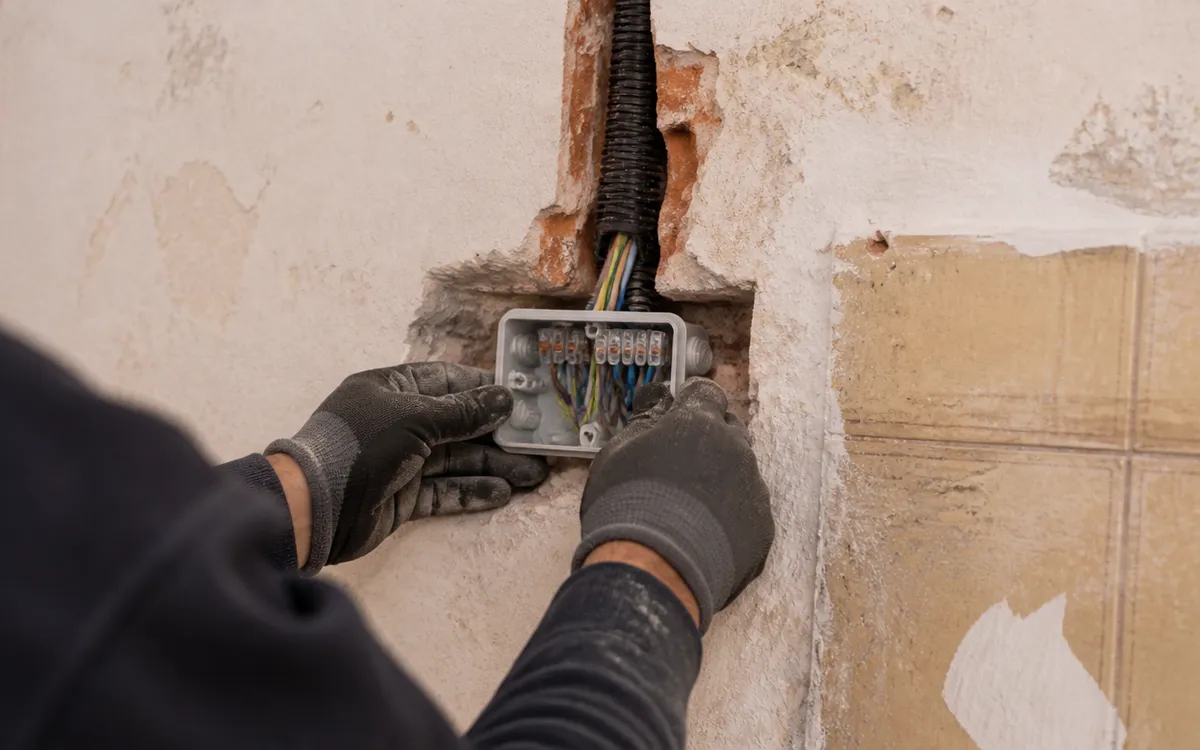
When hanging a TV, a shelf or the kitchen wall units, the drill bit hits the conduit running down to a socket or a switch. There is usually a flash, the circuit breaker or the RCD (trip switch) trips and that area loses power; don't reset the protection to test it. We locate the spot, open up as little of the wall as possible, cut out the damaged section and make the joint inside an accessible junction box, or pull through new cable if the conduit allows. Before switching the power back on we check the entire circuit.

Cable cut during building work or a renovation

An angle grinder cutting a chase, a hammer chipping off tiles or a mini digger in the garden can cut a line nobody could see. It happens a lot in kitchen and bathroom renovations, pool building work and trenches for irrigation or fencing. We isolate the line, locate both ends and decide between a joint and a new cable based on the size, type of cable and its route. On buried lines we use cable suitable for burial, inside conduit and with its warning tape.

Cable ripped off the façade by an impact

A delivery van, an awning coming loose, a ladder or the leaf of a garage door can rip off the cable running along the façade to a light, a camera, a motor or a sign. If the cable is hanging, don't touch it or let anyone walk underneath. We cut the line, remove the ripped-out section, replace clips, conduit or trunking and rerun it protected and at a height where it won't get damaged.

Cables damaged by a storm in the garden or on the plot

Strong wind, heavy rain and falling branches damage overhead lines between the house and the garage, pole-mounted floodlights, festoon lights and garden lamp posts. If there is a cable on the ground, keep everyone away and don't touch it even if it looks dead. We cut the supply at the fuse box, remove and replace the damaged sections and, when it makes sense, move the overhead line underground so the next storm doesn't bring it down.

Bare cable or cracked sheathing

The cables feeding a pump, the pool motor, an awning or an outdoor light crack in the sun and salty air; indoors, the flexes of lamps and appliances wear through from bending and from furniture being dragged over them. A live bare cable is a direct risk of electric shock. We replace the whole cable with one suitable for outdoor use or for its purpose, with no patching: insulating tape is not a repair.

More cases we deal with

  • Cables chewed by rodents in the false ceiling

    Rats and mice in false ceilings, cavity spaces and garages chew through the sheathing. We check the cable routes, replace the damaged sections and protect them with conduit.

  • Cable crushed under furniture or a door

    Extension leads and lamp flexes trapped under a furniture leg or caught in a door. We replace the cable and, if you need a socket closer by, we install one.

  • Damaged well or irrigation pump cable

    Submerged or buried cables that get cut by friction or by garden tools. We replace the cable and make watertight joints suitable for working under water.

  • Buried line to the pool or an outbuilding cut

    Irrigation trenches, planting or fencing that cut the line to the pool pump or an outbuilding. We locate the cut, replace it with cable suitable for burial and protect it with conduit.

  • Cables burnt by a short circuit

    After a short circuit, the section near the fault usually ends up with melted sheathing. We replace it back to where the cable is sound and check the protective device that tripped.

  • Cloth or rubber cables falling apart

    In very old installations, the insulation crumbles as soon as you touch a fitting. We replace that circuit and explain the condition of the rest.

  • Damaged solar panel or charger cable

    DC cables chewed on the roof or wallbox cables run over by the car. We replace them with cable suitable for that use.

  • Loose cables in an industrial unit or warehouse

    Fallen cable trays or cables crossing aisles used by forklifts. We put the trays back and run the cables along protected routes.

  • Communal wiring damaged by building work

    Façade or plumbing work that affects the lighting in the entrance, stairwell or garage, or the pump supply. We repair it and check all the communal services.

  • Door entry system or doorbell cable cut

    A renovation or a tampered junction box leaving the home without its door entry system. We locate the cut section and replace it.

  • Cable dried out next to a fireplace or oven

    Cables running too close to a heat source and cracking. We replace them with more heat-resistant cables and move them away from the source.

What to do if you see a damaged or fallen cable

If the cable is inside your home or on your plot, switch off that circuit's breaker or the main switch before going near it. Don't touch it, don't cover it with tape and don't try to join it: even if you see no sparks, it may be live.

If there is a cable down in the street, on a pole or on the public road, don't go near it or move it with anything. Keep people away and call the distribution company (distribuidora), whose faults number appears on your bill, or 112 if there is immediate danger.

If the drill bit has hit a cable and is stuck, don't pull it out until the power has been cut, and don't reset the protective device that tripped.

Joint or new cable: how we repair it

A damaged cable has two correct solutions. When the damage is localised and the cable is sound, we cut out the affected section and make the joint with connector terminals inside an accessible junction box: Spain's Low Voltage Electrotechnical Regulation (REBT) requires connections between conductors to be made inside suitable boxes and does not allow them to be joined by twisting them together. When the cable is old, dried out or damaged in several places, the right thing to do is to replace it entirely.

We keep to the original cable size or the one that matches the circuit's protection, the regulation colours (blue for neutral, green and yellow for earth, brown, black or grey for the phases) and the right type of cable for the location: indoor, outdoor, buried or submerged.

Street cables, communal cables and your own

The street network, the poles and the service cable up to the building's main service box (caja general de protección) belong to the distribution company. The user's installation starts from that box, and that is where we work: lines in residential buildings, garages and communal services, homes, shops, industrial units, gardens and plots.

What you get

What you get when we do it

  • Power off before we touch anything

    We cut the power and confirm there is no voltage before any handling.

  • Accessible joints

    No hidden joints and no tape: proper terminals inside accessible boxes.

  • The right cable for each location

    Indoor, outdoor, buried or submerged, with the size the circuit requires.

  • Protected cable routes

    We replace conduit, trunking and clips so the cable doesn't get damaged again.

How we work

How we fix it, step by step

  1. You tell us what happened

    Through the form or by email: which cable, where it is and how it was damaged, with a photo if you can.

  2. We cut the power and mark off the area

    We isolate the line and mark off the area so nobody goes near it.

  3. We repair or replace

    A joint in an accessible box or a new section, using the right cable.

  4. We test the circuit

    We test insulation and continuity and check the protective devices before restoring power.

Frequently asked questions

Questions about damaged cables

What should I do if I've drilled through a cable?

Let go of the drill without touching the bit and leave off whatever protective device has tripped; don't reset it to test it. Write to us: we will locate the cable, open up only what is needed and make the repair inside an accessible box or with new cable.

Can a bare cable be fixed with insulating tape?

Not as a repair. Tape can be used to insulate the end of a dead cable for a moment, but with heat and time it comes unstuck and leaves the copper exposed again. A bare cable has to be cut and joined in a box, or replaced.

There's a cable down in the street. Can you repair it?

No: the street network belongs to the distribution company and only they can work on it. Move away, keep people back and call the distribution company on the faults number on your bill, or 112 if there is danger. If the cable is inside your plot or part of your installation, then yes, we repair it.

What colours are the cables in an electrical installation?

Under the REBT, neutral is blue, the protective or earth conductor is green and yellow, and the phases are brown, black or grey. In older installations it is common to find other colours or cloth-covered cables, a sign that they should be checked.

Can rodents damage cables?

Yes, and it is more common than you might think in country houses, garages, false ceilings and industrial units. They chew through the sheathing and leave the copper exposed, which can cause short circuits and fire. We replace the chewed sections and protect them with conduit.

You may also be interested in

Related services

Rewiring

Old installations with no earthing or two-wire circuits, kitchen and bathroom refits, shops, new-build villas, air conditioning lines and swimming pools.

See the service

Is it happening right now?

Tell us what is happening, where it is and a phone number. In the meantime, if there is a burning smell, sparks or water, switch off the main switch only if you can do it safely.