Skip to content
electricistaentrevegas.comReport a fault
Menu

Garage doors, barriers and electric shutters that won't open or close

A garage door that won't open leaves your car stuck inside or out; a metal shutter that won't come down stops you locking up your shop. We find the electrical fault in the motor, control board, photocells or remote and repair it so it works again with all its safety features.

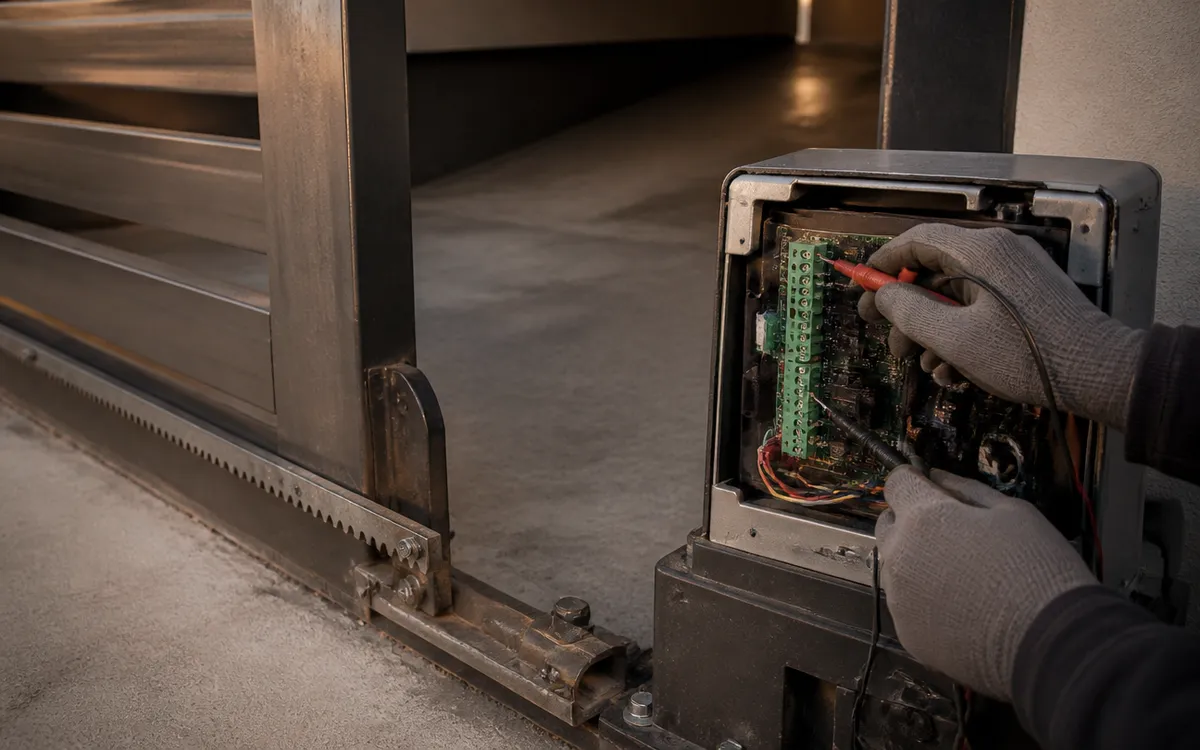
Garage door or electric shutter repair: electrician checking the motor of a sliding garage door

No power or equipment down

Garage doors and shutters: what it involves

An automatic door is a motor run by a control board that obeys the remote, push button or key switch, and that stops or reverses when the photocells, safety edge or limit switches tell it to. If one of those parts fails, the door won't open, won't close, stops halfway or opens by itself, and it can almost always be diagnosed by measuring, without taking it apart.

We repair sliding, swing, up-and-over and sectional doors for homes and communities, car park barriers, metal shop shutters, electric roller shutters with tubular motors and automatic glass doors in shops and pharmacies.

If the door is stuck, we first leave it in a safe position, open using the manual release or closed and secured, and then repair the part. If the fault is mechanical, a spring or a suspension cable, we tell you clearly.

Cases and jobs

Doors, barriers, shop shutters and roller shutters we repair

The ones we are asked for most, with an explanation, followed by the other jobs in this service.

Garage door not working with the remote

If it doesn't respond to the remote but does to the push button or key switch, the fault is in the remote or the receiver. We check the battery and transmission, the receiver and its aerial, often damaged by knocks or the sun, and the code memory. We program new remotes, replace a burnt-out receiver and reprogram every resident's remote in a community.

Door closes and opens again: the photocells

If the door starts to close and reverses, or won't close, the photocells almost always can't see each other: knocked out of alignment, dirty, covered in cobwebs, with water inside or without power. We clean and align them, measure the transmitter and receiver, replace the pair if damaged and check that the door stops and reverses when it meets an obstacle.

Motor hums but the door doesn't move

In many sliding and swing gate motors, humming without movement points to a worn-out start capacitor. Other times it's the manual release half engaged, a stuck limit switch or a damaged winding. We test the motor and capacitor, check the controls and replace the part, or the motor with a compatible one if it's burnt out.

Shop's metal shutter that won't come down

A shop that can't lower its shutter can't leave. The central motor, electric brake, push button or key switch, limit switch or the power supply from the panel can fail. We bring it down so the premises are secure and repair the motor, brake or controls so it goes up and down normally again.

Electric roller shutter that won't go up or down

Roller shutters with tubular motors fail because of the switch or remote, misadjusted limit switches, the thermal cut-out, which kicks in after many operations in a row, or the motor. We check whether power is arriving, test both directions, adjust the limit switches and replace the switch or motor. If it's stuck down in a bedroom or on the way out to the terrace, we raise it first.

More cases we deal with

  • Car park barrier that won't lift

    In communities, hotels and businesses we check the control panel, reader or receiver, detection loops and motor, and leave it working, or safely open until the job is finished.

  • Door that stops halfway

    A badly adjusted limit switch, a damaged safety edge or force detection set too sensitive. We adjust the controls and replace the affected part.

  • Garage door that opens by itself

    An outdoor push button with water in it, a remote pressed inside a bag or a damaged receiver. We find the cause and eliminate it.

  • Nothing works after a storm

    The surge usually burns out the control board or the receiver. We replace whatever is damaged and protect the door's line against surges.

  • Sectional or up-and-over door that won't start

    We check the ceiling motor, carriage, limit switches and controls. With a broken spring it can't be released: we leave it immobilised and explain what needs replacing.

  • Safety edge blocking the door

    When it's broken by knocks or the sun, the controls read it as a permanent obstacle. We replace it and test its response.

  • Outdoor push button or key switch not responding

    They corrode with damp and salt air. We replace them with weatherproof models and check their cable.

  • Automatic glass door that won't open

    In shops, pharmacies and clinics we check the radar sensor, mode selector, emergency battery and the power supply to the door operator.

  • None of the shutters in the house responding

    With central control or home automation, the control unit or its power supply has failed. We repair it and, if needed, add individual switches.

  • Electric roller shutter that goes down but not up

    A burnt contact in the switch or one of the motor's two control wires. We test both directions and repair the one that's failing.

  • Motorised awning that won't retract

    We retract it first so the wind doesn't damage it, then check the motor, remote and wind sensor.

  • Door tripping the community's panel

    A leak in the motor or its line trips the communal RCD every time it operates. We repair it and give the door its own protective device.

What to do if the door is stuck

Almost all motors have a manual release, with a key or a pull cord. Only use it with the door stopped, nobody in its path and if you know how it works.

  • Don't release an up-and-over or sectional door with a broken spring or a slack cable: it can drop suddenly.
  • Move the door slowly without forcing it; if it resists, leave it.
  • Don't put your hand between the leaves, guides or rack.
  • With a roller shutter or shop shutter stuck halfway, don't keep pressing the switch: the motor overheats and cuts out.
  • If you smell burning, switch off the door's protective device in the electrical panel and let us know.

Electrical or mechanical fault: how to tell

If nothing happens when you give the command and no remote responds, it's electrical: power supply, protective device, control board, receiver or motor. If the motor runs and the door doesn't move, it may be the capacitor, the manual release or a drive part. If it's hard to move even when released, it's mechanical.

We take care of all the electrical and electronic side, and show you on the door itself what has failed.

Safety features we leave tested

A door that works but doesn't stop for an obstacle is more dangerous than a broken one. After every repair we check that the photocells stop it closing, that the safety edge reverses it, that the limit switches stop the motor in the right place and that force detection works. On roller shutters, we check that the motor doesn't force the slats against the box or the floor.

What you get

What you get when we do it

  • Diagnosis at the door itself

    We measure the power supply, controls and motor on site to find out which part is failing.

  • Safety features tested

    Photocells, safety edges and limit switches tested before we leave.

  • Remotes and receivers

    New remotes programmed and receivers reprogrammed for the whole community.

  • Homes, communities and businesses

    Doors, barriers, shop shutters and roller shutters in Murcia and on the coast.

How we work

How we fix it, step by step

  1. Tell us the symptom

    Type of door, what it does when you give it the command and whether you can see a broken spring or cable.

  2. We test the controls

    Power supply, control board, receiver, photocells, limit switches and motor.

  3. We repair the part

    With a replacement compatible with your door or shutter.

  4. We test the safety features

    Several full cycles with an obstacle, the remote and the push button.

Frequently asked questions

Questions about garage doors and shutters

My garage door isn't working. Is it the motor?

Not necessarily. The remote, receiver, photocells, control board or power supply tend to fail first. If the motor makes no noise, we check the power and the board; if it hums without moving, the capacitor; if it starts and stops, the safety features. A burnt-out motor is the last suspect.

Why does my garage door start to close and then open again?

Almost always because of the photocells: misaligned, dirty, wet or without power, so the controls think there's an obstacle. It can also be a damaged safety edge. Cleaning the lenses with a dry cloth is sometimes enough; if not, we check them.

My garage door remote isn't working. What should I do?

Try another remote or the push button. If the others work, change the battery in yours; if it still doesn't work, it has probably lost its code. If no remote works but the push button does, the receiver or its aerial is at fault.

My electric roller shutter has stopped halfway. Is it broken?

It may be the motor's thermal cut-out, which disconnects it after several operations in a row: leave it to rest for a while and try again. If nothing changes, a limit switch, the switch or the motor is at fault, and we test it at the switch box.

Can you leave the door open or closed while it's being repaired?

Yes. We leave it open using the manual release or closed and secured, so the garage or premises aren't left exposed, and then carry out the repair.

Why did the door stop working after a storm?

Surges from nearby lightning come in through the power line or through the photocell and push-button cables and burn out the control board or receiver. We replace the damaged part and suggest a surge protector.

You may also be interested in

Related services

Communities of owners

Stairwells, garages, pumps, pressure booster sets, emergency lighting and door entry systems: we repair faults in your building's communal services.

See the service

Where

Areas where we do it most

As well as Murcia and its districts, we handle it with home call-outs in these areas.

Is it happening right now?

Tell us what is happening, where it is and a phone number. In the meantime, if there is a burning smell, sparks or water, switch off the main switch only if you can do it safely.