Electrician in Alcantarilla for faults, emergencies and installations
We come out from El Palmar to Alcantarilla to work on houses in the old quarter, flats from the seventies and eighties, huerta farmhouses and industrial units. We track down the fault, make the installation safe and repair it.
Alcantarilla is a town right next to Murcia on its western side, with the A-7 alongside and the traditional huerta (irrigated market-garden land) still alive on its edges, with irrigation channels and the odd waterwheel. Within a few streets you find single-storey houses with a patio, four- or five-storey buildings put up in the seventies and eighties, newer developments of terraced houses and a good number of workshops, warehouses and industrial units. For an electrician, that means coming across installations from very different periods, each with its own typical faults.
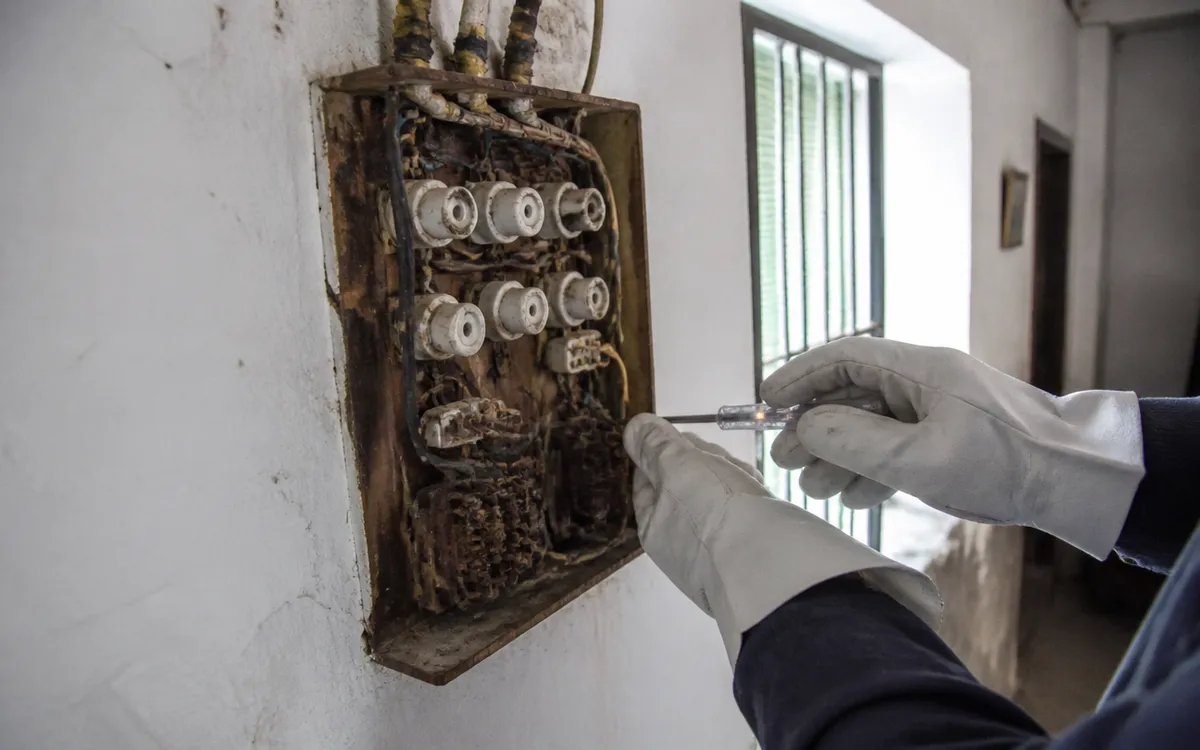
In the older houses in the centre and the traditional neighbourhoods we still find cloth-covered cables, sockets without an earth, joints buried in plaster boxes and consumer units with a single RCD (residual current device) for the whole home. In flats from the boom years the problem is usually capacity: they were designed for a fridge, a washing machine and little else, and today they carry air conditioning in several rooms, an oven, an induction hob and an electric water heater. When everything runs at once, the main switch trips or a socket that has been working at its limit for years overheats.
Out in the huerta and in the country houses around the municipality, faults come from distance and damp: long cable runs to the house or to the well pump, cables buried without conduit, inspection pits that fill with water when the land is irrigated, and earth connections nobody has measured in decades. In the units and workshops of the industrial areas, the usual problems are lost phases that stop machinery, overheated sub-distribution boards and extensions that need more power or a switch to three-phase.
Cases and jobs
Faults and jobs we handle most in Alcantarilla
The faults and jobs we come across most here. Each one links to its service.
In seventies flats with a single circuit for the kitchen and living room, the protection cannot cope with the combined load. We measure actual consumption, split the circuits and match each circuit breaker to the size of its cable.
We replace the old wiring with halogen-free cables in conduit, add an earth and leave a consumer unit with separate circuits for lighting, sockets, kitchen and bathroom.
A knock from a rotavator or a hoe strips the cable running to the pump or the shed and the whole house trips. We isolate the line, find the damaged section and replace it with cable rated for burial, laid in conduit.
In many single-storey houses the washing machine sits in the patio, with the socket exposed to the weather and a loose plug. We replace the socket with a weatherproof one, check the cable back to the box and make sure the circuit has the right cable size.
Three-phase machinery stops or hums and some of the lights dim. We find out whether the phase is being lost at the main board, in a fuse or at a loose terminal and restore it; if the fault comes from the grid, we tell you how to report it to the distribution company.
It is almost always an electric water heater with a leaking element and an earth that is not working. We disconnect the water heater, measure the earth connection and leave the RCD working as it should.
We repair the stairwell lighting, replace timers and push buttons and, if the residents' association asks, fit motion sensors and LED fittings so the entrance is never left in the dark again.
Houses that have been shut up for years usually have the supply cancelled, and the distribution company asks for a new certificate. We check the installation, correct anything that does not comply and issue the CIE (electrical installation certificate) so you can take out a contract.
If the main switch trips every time the split unit starts, we calculate the power the home needs, check that the supply cable from the meter (derivación individual) can carry it and prepare the paperwork to increase it.
In houses with a garage and in block garages we check the motor supply, the control board, the photocell and the limit switches until the door opens and closes without forcing it.
We remove the fuse box or single-RCD board and fit a new one with RCDs by group, a circuit breaker for each circuit and surge protection.
Huerta, wells and country houses around Alcantarilla
Huerta houses have electrical problems you never see in a flat. The installation has grown over the years with additions for the irrigation pump, the store, the garage or the barbecue, and very often everything hangs off a single RCD. When the pump or an outdoor floodlight starts leaking current because of damp, the whole house goes off and there is no way of telling where the problem is.
What we do is separate things: one protection for the house, another for outdoor uses and another for the pump, so that a fault outside does not cut power to the fridge or the freezer. We measure the resistance of the earth connection and, if it is poor, drive in new earth rods and connect them to the installation.
Buried lines to the well or the shed, in conduit with accessible inspection pits
Weatherproof outdoor board for the irrigation pump
Patio and garden lighting with fittings rated for outdoor use
Earth connection measured and recorded in the paperwork
What to do if the power goes off in your Alcantarilla home
First check whether it is just your home: if the neighbours or the street lights are also out, the cut comes from the grid and you need to notify the distribution company. If it is only your house, open the consumer unit door and see what has dropped: the RCD, a particular circuit breaker or the main switch.
If the RCD trips again as soon as you push it back up, leave it down and unplug appliances in damp areas such as the patio, the utility room or the garage. Do not touch the consumer unit with wet hands or remove the cover over the cables. Tell us in the form what happened and which protection has tripped, and we will come with what we need to find the fault.
Old installations with no earthing or two-wire circuits, kitchen and bathroom refits, shops, new-build villas, air conditioning lines and swimming pools.
Do you work in the Murcia districts that border Alcantarilla?
Yes. As well as the town and the huerta of Alcantarilla, we cover Javalí Nuevo, Javalí Viejo, La Ñora, Sangonera la Seca, Nonduermas and the other nearby districts. The type of housing is very similar, and so are the faults: old houses, haphazard extensions and irrigation pumps.
My seventies flat has no earth on the sockets. Does it need one?
Spain's Low Voltage Electrotechnical Regulations (Reglamento Electrotécnico de Baja Tensión) require an earth in new installations and in refurbishments, and it is what allows the RCD to really protect you against an electric shock. We check whether the building has an earthing network and, if it does, we run the protective conductor to every circuit and replace the old sockets with earthed ones.
Do you issue certificates for huerta houses or industrial units in Alcantarilla?
Yes. We issue the electrical installation certificate (boletín eléctrico) for homes, country houses, garages, warehouses and industrial units. First we check insulation, earthing and protections, and if anything does not comply we correct it so that the certificate reflects a real, safe installation. It is then registered with the regional government of the Región de Murcia and you can take out a contract or change your power.
Why does the RCD trip every time it rains?
There is almost always water reaching a live point: a junction box on the façade, a patio floodlight, an outdoor socket without a cover or a garden inspection pit. Damp lowers the insulation and the RCD cuts out. We test circuit by circuit to find the exact spot, dry it or replace it, and leave it protected with weatherproof materials.
Can you extend the installation in a workshop or warehouse?
Yes. We calculate the loads of the new machinery, extend the board, run lines with the right cable size and, if you need more power or to move from single-phase to three-phase, we prepare the technical documentation for the change with the distribution company.