Skip to content
electricistaentrevegas.comReport a fault
Menu

Flickering lights, intermittent power cuts and phase loss

Flickering that repeats in several rooms, a light that dims when something starts up or a three-phase machine that stops while the rest of the warehouse keeps running are symptoms of a failing connection or a phase that isn't arriving. We measure the voltage in the right places, find the point and repair it.

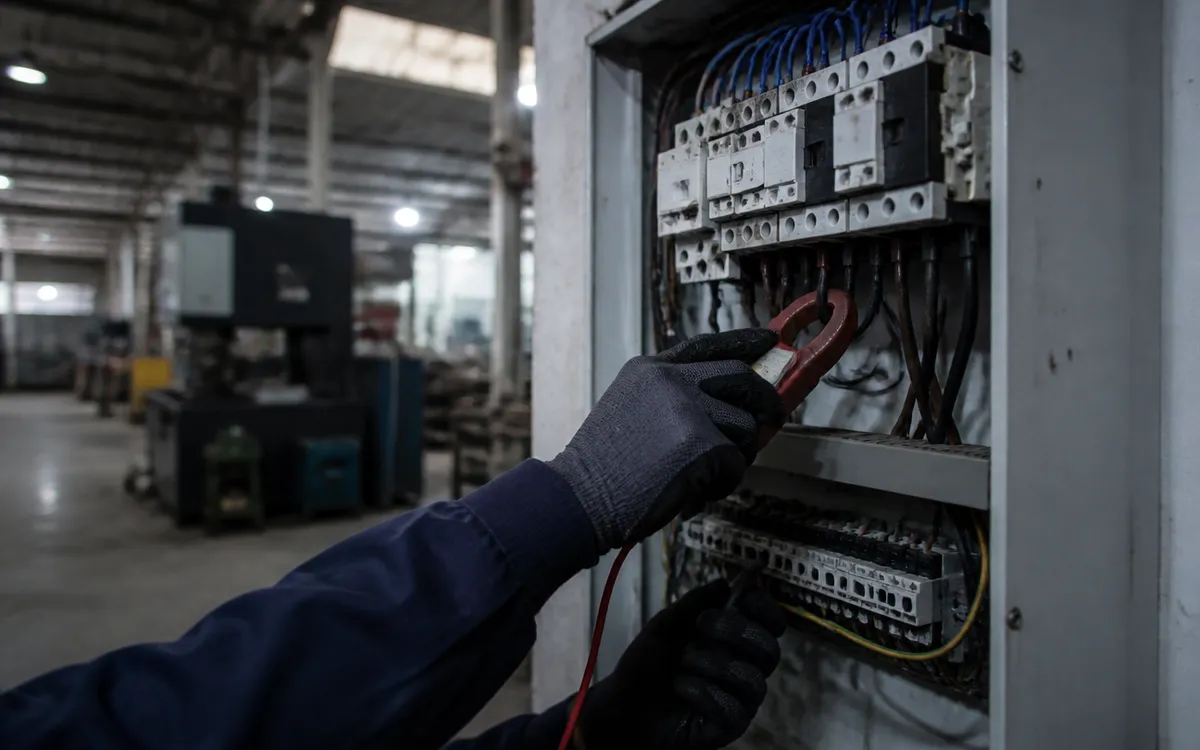
Electrician testing a three-phase panel in a warehouse with flickering lights and phase loss

No power or equipment down

Flickering and phase loss: what it involves

If a single bulb flickers, it's usually the bulb. If several flicker at once or the lights dim when the washing machine or air conditioning starts, the problem is in the installation: a loose connection heating up, a neutral in poor condition or a voltage drop on a long or undersized line. It won't fix itself and usually ends in a burnt terminal.

In three-phase installations, such as those in warehouses, shops, large villas and communal services, there's also phase loss: only two of the three phases arrive, some of the lights and sockets go off and the motors of pumps, compressors or lifts stop or hum without starting. Running them like this burns them out.

We measure with a multimeter and a clamp meter at the consumer unit and on the supply line and, if the fault is elusive, we leave a voltage logger in place. That way we know whether the fault is yours, the building's or the network's.

Cases and jobs

Flickering, intermittent cuts and lost phases we repair

The ones we are asked for most, with an explanation, followed by the other jobs in this service.

Lights flickering throughout the house

If the flickering affects several rooms, the cause is at a common point: the neutral terminal, the main switch connection or the meter output. The loose connection makes the voltage fluctuate with every appliance that switches on, and it heats up until it burns. We measure under load, remake the connection and replace any damaged terminals and protective devices.

Phase loss in a three-phase warehouse or shop

With one phase missing, part of the lighting goes off and three-phase machines stop or hum. We measure all three phases from the main service fuse box to the consumer unit to find the blown fuse, burnt terminal, damaged pole on the main switch or cut cable. We repair it and, if you don't have one, install a phase monitoring relay so machines stop on their own instead of burning out.

Three-phase pump stopped by a missing phase

Pumps for wells, irrigation, pools and pressure booster sets are the first to notice: the motor protection breaker trips or the motor hums without turning. We measure the phases, check contactors, motor protection breakers and motor terminals, repair the section that has failed and test the winding insulation before starting it again.

Lost neutral with damaged appliances

If the neutral of a building or a three-phase installation comes loose, some circuits get too little voltage and others too much: bulbs shine too brightly and appliances burn out. We measure between phases and neutral, locate the damaged terminal or joint and remake it. We give you a written record of what we found, useful for your insurance or for claiming from the distribution company if the fault came from the network.

Intermittent cuts that come back on their own

The power goes for an instant and comes back, several times a day, without anything tripping. It's caused by a connection that makes and breaks contact: a loose terminal on the supply line, a charred joint or a main switch with pitted contacts. We measure under load, look for hot spots and, if needed, leave a logger to capture the cut.

More cases we deal with

  • LED bulbs glowing faintly when switched off

    A switch with an indicator light or a long switch cable lets a tiny current through. We replace the switch or fit a residual light suppressor.

  • LEDs flickering with the dimmer

    Many LED lamps aren't dimmable or don't work well with an old dimmer. We replace the dimmer with an LED-compatible one or the lamps with dimmable models.

  • Lights dimming when the air conditioning or oven starts

    This indicates a borderline cable size or a high-resistance connection. We measure the voltage drop and correct the line or the connection.

  • Flickering in a workshop when the compressor starts

    We check the line, the motor's starting system and the load balance across phases so each start-up isn't felt throughout the building.

  • Villa or country house with low voltage

    We measure at the supply origin and at the consumer unit to find out whether it's the network or the internal line, and replace the line with one of the right cable size.

  • Lift and communal motors with phase faults

    When the lift or the pumps fail intermittently, we check the three-phase line for communal services, its terminals and its protective devices.

  • Cold room stopping due to a missing phase

    Losing a single phase is enough for the compressor to stop cooling. We locate the fault and fit phase monitoring with an alarm.

  • Flickering light panels and tubes in an office

    Worn-out tubes, starters or faulty ballasts. We replace the light fittings with LED and check the circuit that feeds them.

  • Flickering when it rains or is windy

    Water in a box on the façade or damaged connections on the overhead service line. We repair your part and, if it's the service line, explain how to report it to the distribution company.

  • Unbalanced phases in a three-phase installation

    If the large loads all hang off the same phase, that phase overheats and its voltage drops. We redistribute circuits to balance them.

  • Electronic equipment restarting on its own

    Routers and computers that restart reveal micro-cuts. We measure the supply, correct the installation and suggest a UPS for the most sensitive equipment.

Flickering from your installation or from the network: how to tell

If the neighbours and the street lights also flicker, or it coincides with storms and outages in the area, it almost always comes from the network. If it only happens in your home or premises, or gets worse when you switch on large appliances, the fault is internal.

If in doubt, we measure right after the meter. If the supply is already poor there, we explain how to claim from the distribution company using the measurement data; if it arrives fine and is lost inside, we repair it.

What to do if you lose a phase or notice abnormal voltage

A lost phase or a loose neutral damages motors and appliances very quickly. While we're on our way:

  • Stop any pumps, compressors and machines that are humming, and don't try to start them again.
  • If bulbs are shining too brightly or appliances switch off on their own, turn off the main switch.
  • Unplug computers, televisions and appliances with electronics.
  • Don't open the consumer unit: even if one phase is missing, the others are still live.

Causes we find behind flickering lights

Almost always a deteriorated connection: heat loosens terminals day by day and, with damp or salt air, corrosion speeds up the process.

  • Loose terminals on the main switch or at the meter output.
  • Deteriorated neutral in the consumer unit or on the supply line.
  • Joints made with insulating tape in old junction boxes.
  • Cable sizes too small for the power used today.
  • Large loads poorly distributed across phases.

What you get

What you get when we do it

  • We measure under load

    Many faults only appear when the installation is working; we trigger them and measure them.

  • We protect your motors

    Phase monitoring relays so pumps and compressors stop before they burn out.

  • We tell you whose job it is

    If the fault is on the network, you take the measurement with you to make your claim.

  • We prevent the burnt terminal

    A loose connection repaired in time doesn't end in a burnt-out consumer unit.

How we work

How we fix it, step by step

  1. Describe the symptom

    What flickers, when, with which appliance and whether the installation is single-phase or three-phase.

  2. We measure voltage and load

    Meter, consumer unit and circuits, with and without load, phase by phase.

  3. We repair the weak point

    Connections, terminals, protective devices or the affected section of line.

  4. We test with everything running

    We start motors and large appliances and check that the voltage stays steady.

Frequently asked questions

Questions about flickering and phase loss

Why do the lights in my house flicker?

If it's a single bulb, it's usually the lamp or its holder. If several flicker at once, there's a loose connection at a common point, a deteriorated neutral, a voltage drop when large appliances start or a problem on the network.

Is flickering light dangerous?

General flickering can be the first warning of a connection that's heating up. Without a burning smell or sparks it isn't an immediate emergency, but it should be checked soon. If you smell burning, switch off the main switch and tell us.

What is phase loss?

A three-phase supply has three phases. If one is interrupted by a fuse, a burnt terminal or a cut cable, its circuits go off and three-phase motors run badly or stop, and continuing to use them like that can burn them out.

Why do LED bulbs stay slightly lit when switched off?

A tiny current reaches them through a switch with an indicator light or through cables that run together over a long distance. It isn't dangerous, but it's annoying and shortens their life. It's solved by replacing the switch or with a small component next to the light.

The lights flicker throughout the building. Who fixes it?

It may be on the building's main supply line, in the centralised meter panel or on the network. We measure at the building's intake and, if it's the community's responsibility, we repair it with the approval of the property manager or the community president.

Does a phase monitoring relay stop motors burning out?

That's its job: it checks that all three phases arrive with the correct voltage and sequence and, if any fails, disconnects the motor before it's damaged. We fit them on pumps, cold rooms, compressors and machinery.

You may also be interested in

Related services

No power at home

Total or partial outage in a home, residential building, shop or warehouse: we find where the current is interrupted and restore the supply.

See the service

Is it happening right now?

Tell us what is happening, where it is and a phone number. In the meantime, if there is a burning smell, sparks or water, switch off the main switch only if you can do it safely.